Mudharabah is a form of business cooperation in Islamic finance where one party provides capital (shahibul maal) and the other provides expertise and labor (mudharib). It is important for both parties to understand how losses are shared in this contract, especially through the analysis of the income statement. A good understanding of loss distribution helps maintain trust and harmonious cooperation between both parties.
Fundamentals of Mudharabah Contract
Mudharabah allows cooperation between the owner of the capital and the business operator without guaranteeing profits. The shahibul maal provides all the necessary capital, while the mudharib is responsible for managing the business. Profits obtained from the business are shared based on the initial agreement, but any losses are borne entirely by the shahibul maal, unless the losses are due to negligence or misconduct by the mudharib.
Understanding the Income Statement in a Mudharabah Contract
The income statement is a financial document that reflects a business’s revenue and expenses over a specific period. In the context of a mudharabah contract, this statement is crucial for determining whether the business generates profits or incurs losses. The main components of the income statement include revenue, cost of goods sold, gross profit, operating expenses, and net income.
1. Revenue: Total sales or income from business activities.
2. Cost of Goods Sold (COGS): Direct costs associated with the production of goods or services.
3. Gross Profit: Revenue minus COGS.
4. Operating Expenses: Operational costs not directly tied to production.
5. Net Income (Loss): Gross profit minus operating expenses.
Let’s Visit, Zeed and join for halal investment with Zeed.
Calculating Losses in a Mudharabah Contract
To understand how losses are shared in a mudharabah contract, let’s look at the following income statement example:
Income Statement Example
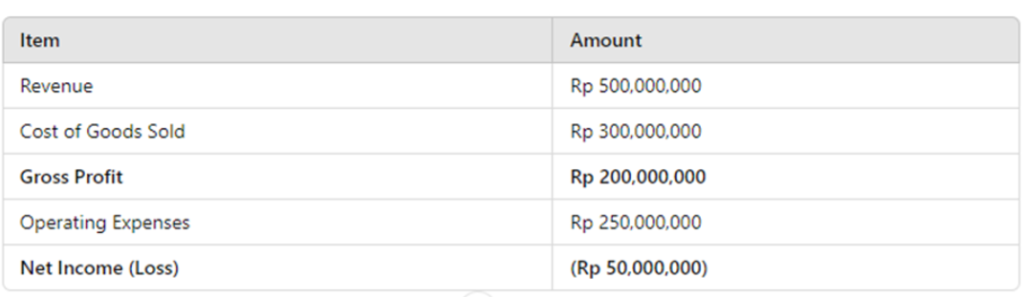
From the example above, the business incurs a loss of Rp 50,000,000. In a mudharabah contract, this loss will be borne by the shahibul maal as they bear the financial risk. However, if the loss is due to negligence or misconduct by the mudharib, the mudharib may be held responsible for covering the loss.
Also Read: Types of Mudharabah in Islamic Finance
Case Study and Example Calculation
Suppose in this mudharabah contract, the shahibul maal and mudharib have agreed to a profit-sharing ratio of 70:30. However, due to the loss incurred, the shahibul maal has to bear the entire loss of Rp 50,000,000.
Steps for calculating loss sharing:
1. Identify net loss from the income statement: Rp 50,000,000.
2. Determine the proportion of loss borne by the shahibul maal (100% of the loss): Rp 50,000,000.
3. Analyze the cause of the loss to ensure there is no negligence or misconduct by the mudharib.
In this example, the loss of Rp 50,000,000 is borne entirely by the shahibul maal, in accordance with the principles of the mudharabah contract. The shahibul maal needs to conduct a thorough analysis of the income statement and operational activities to ensure that the loss is purely from business risks and not due to mismanagement by the mudharib.
Best Practices in Managing Mudharabah Contracts
To ensure the mudharabah contract runs smoothly, several best practices can be applied, including:
1. Open Communication: Maintain good communication between shahibul maal and mudharib to ensure both parties always have accurate and up-to-date information about the business condition.
2. Financial Transparency: Monitor and report finances transparently to prevent misunderstandings and detect potential problems early.
3. Supervision and Audit: Conduct periodic audits to ensure all business activities are carried out in accordance with the agreement and Islamic principles.
Understanding how losses are shared in a mudharabah contract through the income statement is essential for maintaining transparency and trust between shahibul maal and mudharib. The income statement helps both parties monitor business performance and make informed decisions. Therefore, maintaining good transparency and communication is key to the success of a mudharabah contract. Best practices such as open communication, financial transparency, and strict supervision can help minimize risks and ensure the success of this business cooperation.
With a deep understanding and the application of these practices, mudharabah contracts can become an effective business solution that aligns with Islamic principles, providing maximum benefits for both parties involved.
Also Read:Profits Distribution in Mudharabah & Musyarakah: Permissible with High Cash Reserves?
Referensi
Ahmed, H. (2011). Product Development in Islamic Banks. Edinburgh University Press.
El-Gamal, M. A. (2006). Islamic Finance: Law, Economics, and Practice. Cambridge University Press.
Iqbal, Z., & Mirakhor, A. (2011). An Introduction to Islamic Finance: Theory and Practice (Vol. 687). John Wiley & Sons.
Khan, M. F., & Porzio, M. (2010). Islamic Banking and Finance in the European Union: A Challenge. Edward Elgar Publishing.
Obaidullah, M. (2005). Islamic Financial Services. Scientific Publishing Centre, King Abdulaziz University.
Rosly, S. A. (2005). Critical Issues on Islamic Banking and Financial Markets: Islamic Economics, Banking, and Finance, Investments, Takaful and Financial Planning. AuthorHouse.
Usmani, M. T. (2002). An Introduction to Islamic Finance. Kluwer Law International.