
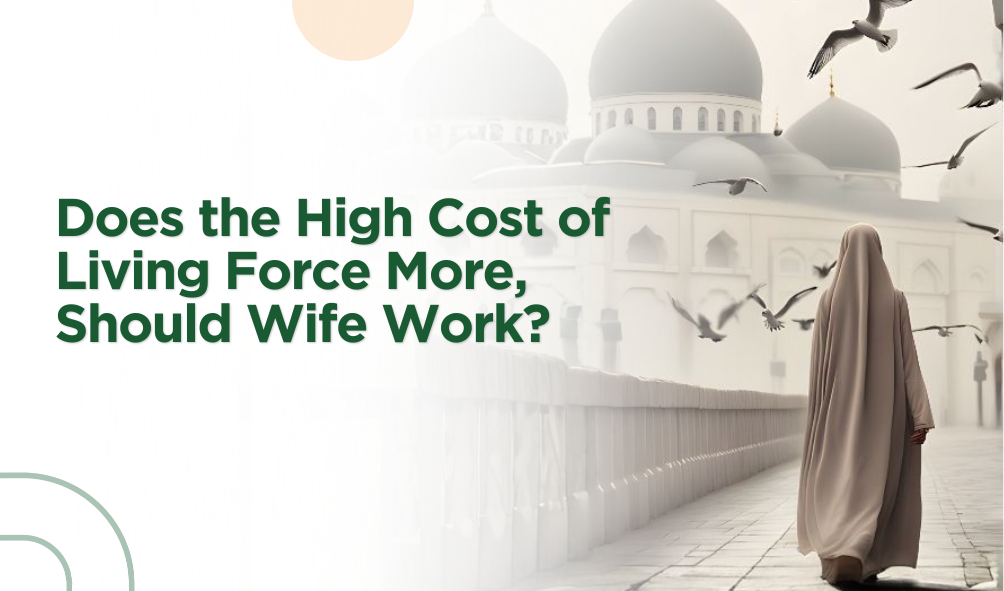
Does the High Cost of Living Force More, Should Wife Work?

Have you ever felt breathless watching your monthly expenses rise? It feels like the high cost of living is getting more and more suffocating. It feels like your salary is just passing through. Husbands are stressed, wives are anxious.
Many husbands are starting to worry. Many wives are becoming anxious, even “forced” to step in to earn extra income. And many households feel like they’ve lost their way.
But amidst these economic pressures, a question is increasingly being asked.
Is the high cost of living the reason wives are forced to work?
Often, yes.
But there’s actually a much more important question for us (husbands).
“With the cost of living this high, is a husband still obligated to provide for his wife alone?” And the Islamic answer is still yes.
Even if we’re willing to put our faith into perspective, this is actually one of the greatest paths to reward. It’s not a burden, nor a punishment, but rather an honor.
A household is Not about Sharing Burdens, but about Sharing Roles.
Many people think Islam makes domestic roles seem burdensome and rigid. In fact, what usually complicates matters isn’t sharia, but rather modern social standards that change and often create new problems.
Allah ﷻ has explained clearly in the Qur’an:
الرِّجَالُ قَوَّامُونَ عَلَى النِّسَاءِ ۢ بِمَا فَضَّلَ ٱللَّهُ بَعۡضَهُمۡ عَلَىٰ بَعۡضࣲ وَبِمَآ أَنفَقُوا۟ مِنۡ أَمۡوَ ٰلِهِمۡ
“Men are the leaders and custodians of women, because Allah has made some of them (men) excel others (women), and because they (men) spend out of their wealth…” (Quran, Surah An-Nisa [4]: 34)
Qawwam is not a dictator. Nor is it a current account that cannot be empty.
Qawwam is the one who protects, calms, carries the burden of livelihood, and ensures that the household ship remains firmly standing, even when the storm of high living costs shakes.
That is why the scholars agree that sustenance (clothing, food, shelter) is the absolute obligation of the husband, even if his wife is rich.
If your wife is a manager? She still has to be supported. If your wife is a doctor? She still has to be supported. If your wife has a successful business? She still has to be supported.
Why? Because Islam teaches clear roles, not sharing the burden of living expenses together. Sharia never stipulates a 50:50 split. Instead, the husband provides (for the family), and the wife is nurtured and protected (as ummun wa rabbah al-bayt ).
Livelihood is a portion of a husband’s glory, not a competition.
Also read: Afraid Your Income Will Stop If You Stay Sharia-Compliant?
High Cost of Living and Blurred Roles
Today’s phenomenon is clear: the high cost of living is a fact. But confusion about who should pay for what is often present, not solely due to economic burdens, but rather because our mindset ( aqliyah ) is starting to become clouded.
Some things that make the role shake:
- Husbands Follow the Current and
Start to Succumb to the Idea that Income Can Be Shared with Their Wives. This is a corrupted mindset, one that views marriage as a business partnership, not a religious trust. - Lifestyle vs. Ability:
Sometimes it’s not the high cost of living that makes things difficult, but rather high aspirations. Our standards of sufficiency shift from what’s enough according to Islamic law to what’s enough according to neighbors or social media. - A Misguided Environment
Today ‘s society often celebrates working wives while downplaying the role of housewives, who are considered unemployed. Yet, the Prophet Muhammad ﷺ highly honored women as mothers and managers of the home. - Communication Breakdown:
The husband is afraid to say, “I’m short .” Or, the wife is afraid to say, “I’m tired.” In the end, both of them walk as if holding their breath.
Also read: A Profitable Business, But Declining Faith? How Come?
The Test is Called the Salvation Reward
Well, this is the important part for us husbands.
It is precisely in the most difficult times, when the high cost of living feels suffocating, that the reward of sustenance becomes even greater.
The Prophet ﷺ said:
دِينَارٌ أَنْفَقْتَهُ فِي سَبِيلِ اللَّهِ وَدِينَارٌ أَنْفَقْتَهُ فِي رَقَبَةٍ وَدِينَارٌ تَصَدَّقْتَ بِهِ عَلَى مِسْكِينٍ وَدِينَارٌ أَنْفَقْتَهُ عَلَى أَهْلِكَ أَعْظَمُهَا أَجْرًا الَّذِي أَنْفَقْتَهُ عَلَى أَهْلِكَ
“Of the many dinars you spend for the cause of Allah, to free slaves, to give alms to the poor, or to support your family, the greatest reward is the one you spend on your family.” (Hadith History of Muslim , no. 995)
If today we (as husbands) have to work harder, turn things upside down, and feel dizzy because of the high cost of living, that is not a sign that Allah ﷻ is making things difficult for us.
This is a sign that Allah ﷻ is opening a door of reward that is rarely opened for others.
Qawwam is Not about Numbers, but Attitude.
This is the part that often makes many husbands waver. We feel like failures when our income isn’t enough, or we feel inferior when our wives willingly join us in the workforce.
After all, qawwam isn’t about the numbers in your bank account. It ‘s about attitude, effort, and steadfastness in upholding your trust.
Our attitude (as husbands) should be:
- Realize that Allah ﷻ judges efforts, not just the end result .
So if we have tried to provide for ourselves through lawful means, even if it’s limited, even if it’s just enough, we are still carrying out His command. - A small but halal livelihood is more noble.
Provision is not about how much it is, but how blessed it is. - Intend your livelihood as daily worship.
Supporting your wife is rewarding. Supporting children is rewarding. Even putting food in your wife’s mouth is charity.
Rasulullah ﷺ said :
إِنَّكَ لَنْ تُنْفِقَ نَفْقَةً تَبْتَغِي بِهَا وَجْهَ اللَّهِ إِلَّا أُجِرْتَ عَلَيْهَا حَتَّى مَا تَجْعَلُ فِي فَمِ امْرَأَتِكَ
“Indeed, you will not spend anything for which you hope to gain Allah’s face, except that you will be rewarded for it, even for what you put into your wife’s mouth.” (Hadith narrated by Bukhari)
If we realize this, then the high cost of living is no longer an enemy, but a field of reward.
Wife Can Help, But Not Responsible
So, can’t a wife help? Of course she can.
Islam does not prohibit a wife from working. The important thing is that she is safe, secure, and that her role as a mother is not diminished, and that her husband is pleased. If a wife chooses to work voluntarily, not through coercion, to help out, it is a noble act of charity.
Most importantly, it’s not the wife who bears the responsibility for providing for the family. The wife may help, but the responsibility remains with the husband.
And behind those heavy shoulders, the reward is opened wide.
Also read: Independent Ruqyah to Protect Your Heart and Business
Conclusion: The Cost of Living May Rise, But the Husband’s Role Should Not Decrease
The economy can fluctuate. Prices can soar. Pressure can become overwhelming.
But one thing that must not change is the glory of a husband as a qawwam .
If we continue to provide for our families despite hardship, continue to strive despite hardship, and continue to carry on despite hardship, then that’s not weakness. It’s proof we’re fulfilling the mandate entrusted to us by Allah .
And every rupiah spent due to the high cost of living, no matter how small, will return in the form of rewards that no one can buy.
“A household doesn’t collapse because of the high cost of living. A household collapses when the husband gives up on his role.”
And we should be men who don’t give up easily. We are qawwam . Our trust is great, but our reward, God willing, is far greater.
May Allah ﷻ always open the doors of sustenance from unexpected directions:
وَمَن يَتَّقِ ٱللَّهَ يَجْعَل لَّهُۥ مَخْرَجًا • وَيَرْزُقْهُ مِنْ حَيْثُ لَا يَحْتَسِبُ
“Whoever fears Allah, Allah will surely provide him with a way out, and provide him with sustenance from a direction he did not expect.” ( Qur’an Surah Ath-Thalaq [65]: 2–3)
Also read: Business Competition, Is It Test or a Threat?
Let’s Visit, Zeed and join for halal investment with Zeed.
Author: Redha Sindarotama
Reference:
Al-Qur’an. Al-Karim. Accessed from: https://quran.com/
Al-Bukhari. Sahih Al-Bukhari , Hadith No. 56. Accessed from https://sunnah.com/bukhari:56
An-Nabhani, Taqiyuddin. The System of Social Interaction in Islam (An-Nizhâm Al-Ijtimâ’î fi Al-Islam) . Jakarta: Pustaka Fikrul Islam
An-Nabhani, Taqiyuddin). Islamic Personality Volume I. Jakarta: Pustaka Fikrul Islam.
Muslim. Sahih Muslim , Hadith No. 995. Accessed from https://sunnah.com/muslim:995