
Have you ever felt uncomfortable when you found out that there were men working in maternity hospitals?
Especially when accompanying your wife during labor. We’re probably already feeling nervous and overwhelmed. And we’re definitely stunned when we find out the doctor is a man.
At that moment, perhaps we can only say, “Oh well, it’s forced, it’s an emergency. The important thing is to be safe.”
But, have we ever taken a moment to ask ourselves: “Why are there male doctors in maternity hospitals?”
Why should our wives, whose honor we protect, at their most vulnerable time (giving birth) be forced to reveal their heavy private parts in front of men who are not mahram?
Here in lies a discussion that’s often overlooked. This isn’t actually a genuine emergency. It’s an emergency created by our collective failure as a people.
This is where the law works for women to move up from mubah (permissible) to fardhu kifayah (collective obligation).
Fardhu Kifayah and The Collective Sins of the Ummah
We certainly know that a woman’s primary and most noble role is as Ummun wa Rabbah al-Bayt (Mother and Manager of the Household). We also agree that the law regarding allowing a wife to work is permissible, not obligatory.
However, in our sharia we also know something called fardhu kifayah.
What is Fardhu Kifayah?
Fardhu kifayah is a collective obligation. Simply put, it’s a single obligation imposed on the entire community (for example, in a city). If someone fulfills it (and in sufficient numbers) to complete it, then the obligation (and sin) is waived for all of us. However, if no one fulfills it, then the entire city is guilty of sin.
A simple and immediate example is taking care of a corpse. If a neighbor dies, someone is obligated to wash, shroud, perform prayers, and bury the deceased. If no one does, the sins of the entire neighborhood can even affect the entire Muslim community.
Well, it turns out, there is a fardhu kifayah that requires women to take jobs that men cannot actually replace.
Also read: Afraid Your Income Will Stop If You Stay Sharia Compliant?
Reality in Maternity Hospitals vs. The Law of Private Parts (Aurat)
This is where the urgency lies.
Maintaining Honor (Izzah) vs. Medical Services
Islam is very strict about maintaining izzah (honour) and private parts. The Sharia orders us (men) to lower our gaze (ghadul bashar) and orders women to guard their private parts.
Allah ﷻ says:
قُلْ لِّـلۡمُؤۡمِنِيۡنَ يَغُـضُّوۡا مِنۡ اَبۡصَارِهِمۡ وَيَحۡفَظُوۡا فُرُوۡجَهُمۡ ؕ
“Say to the men who believe: ‘Let them restrain their gaze, and guard their private parts.‘
وَقُلْ لِّـلۡمُؤۡمِنٰتِ يَغۡضُضۡنَ مِنۡ اَبۡصَارِهِنَّ وَيَحۡفَظۡنَ فُرُوۡجَهُنَّ
“And say to the believing women: ‘Let them restrain their gaze, and guard their private parts.” (Quran Surah An-Nur [24]: 30-31).
On the other hand, when a woman is sick, especially in the maternity hospital (giving birth), she must be helped. This is a matter of life and death.
When giving birth, her private parts will definitely be exposed. Not just ordinary private parts, but mughallazhah private parts (the heaviest private parts).
The Collective Sin Behind Male Doctors
Well, this is where the laws of fiqh “meet”:
Basic law states that it is forbidden for a male mahram to see a woman’s private parts, especially those that are heavy.
Emergency law states that it is permissible (in an emergency) if there are no women available to help.
The question is, why is it that no woman is capable?
This is where the fardhu kifayah of working women lies.
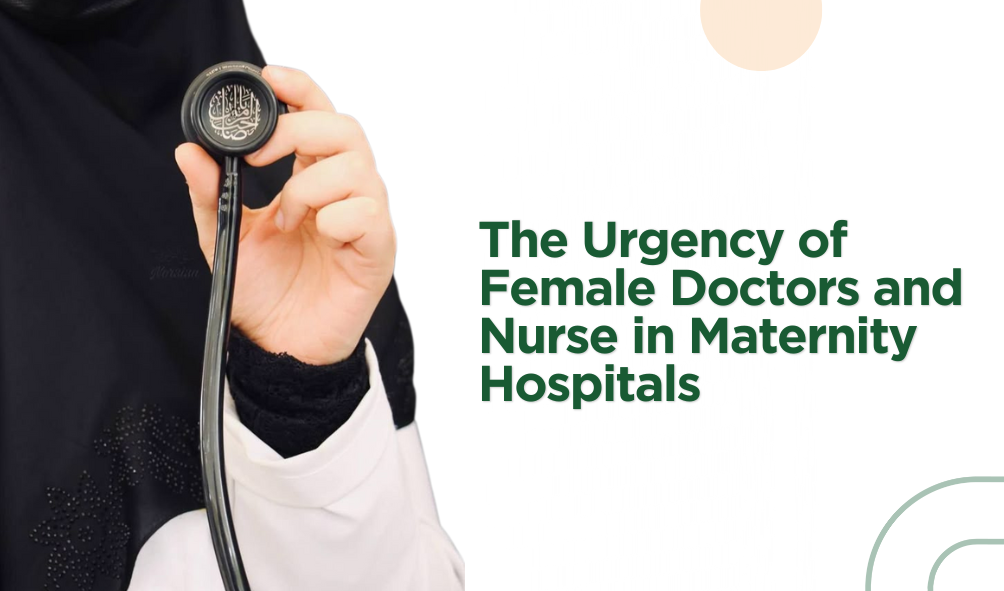
Muslims in a region are obliged (fardhu kifayah) to produce female medical personnel (OBGYN doctors, midwives, nurses) in sufficient numbers to meet needs.
If in a city there are no female obstetricians, so that Muslim women (our wives, our daughters) are forced to give birth under the care of male doctors, who is at fault?
Not just the patient (because it was an emergency). Not just the male doctor (because he saved a life).
The sinners are all of us (Muslims in that city). Why? Because we FAILED to provide female medical personnel or female doctors. We (husbands, fathers and leaders) allow the glory of our sisters to be violated, even though we could have prevented it.
Also read: A Profitable Business, But Declining Faith? How Come?
This is a Call of Trust, Not Just a Career
So, if any of us encourage our intelligent daughters to become obstetricians or nurses, it’s not just about having a good career.
This is a matter of paying off the debts (obligations) of the people.
There is a fiqh rule that states:
“ما لا يتيم الواجب إلا به فهو واجب”
“An obligation that will not be perfect (fulfilled) except with the presence of something (an intermediary), then that intermediary becomes obligatory.”
So the connection is this:
It is obligatory for Muslim women to cover their modesty during childbirth (as much as possible). This obligation cannot be fulfilled unless there are female midwives/doctors. Therefore, employing female midwives/doctors is mandatory (fardhu kifayah).
This is not Western style “emancipation” which sends women out of the house to compete with men. This is a public role required by the sharia itself, in order to maintain the glory of women.
Also read: Independent Ruqyah to Protect Your Heart and Business
Conclusion, Struggle in the Delivery Room
So, the fardhu kifayah that women work is real.
For a woman who (with her husband’s permission and in accordance with Islamic law) dedicates herself to becoming a midwife or obstetrician in a maternity hospital, her intention is no longer merely to earn money.
The intention is to fight, carry out fardhu kifayah and protect the honor of his Muslim sisters (who are in fact our wives).
“Being a housewife is a noble profession (basic mandate). And being a gynecologist (syar’i) is a noble profession that bears the obligations (fardhu kifayah) of the entire community.”
May Allah ﷻ glorify the women who keep the basic trust in their homes, and also glorify the women who (because of lillah ) take the fardhu kifayah trust outside the home.
Also read: Business Competition, Is It Test or a Threat?
Let’s Visit, Zeed and join for halal investment with Zeed.
Author: Redha Sindarotama
Reference:
Al-Qur’an. Al-Karim. Accessed from: https://quran.com/
An-Nabhani, Taqiyuddin. The System of Social Relations in Islam (An-Nizhâm Al-Ijtimâ’î fi Al-Islam). Jakarta: Pustaka Fikrul Islam.
An-Nabhani, Taqiyuddin). Islamic Personality Volume I. Jakarta: Pustaka Fikrul Islam.