
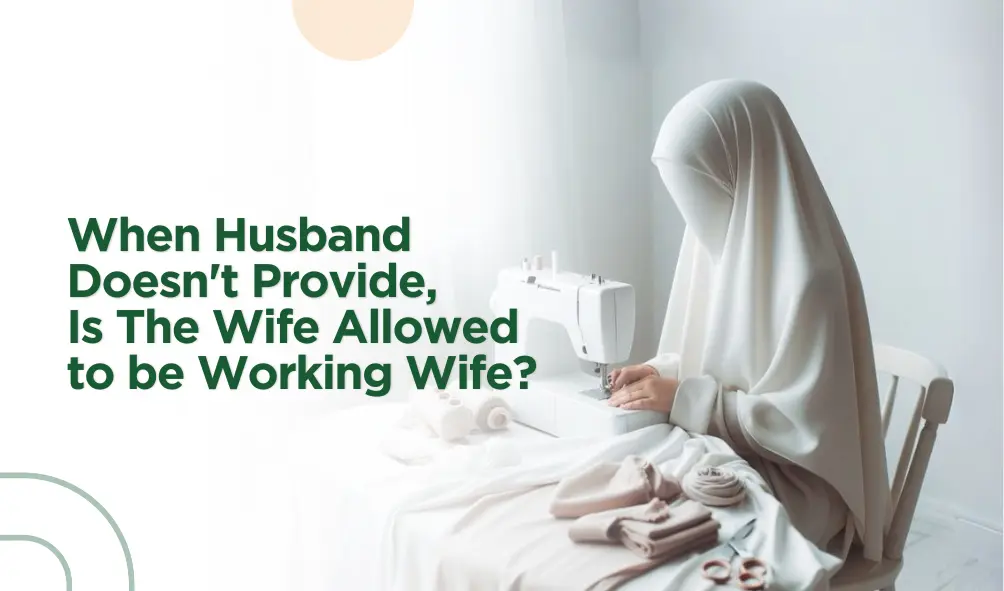
When Husband Doesn’t Provide, Is The Wife Allowed to be Working Wife?

Lately, we’ve been hearing more and more complaints about income. “My wife has to work,” or “My husband doesn’t earn enough.”
And since who knows when, conditions like this have been considered normal.
Nowadays, there’s a term called “split the bills,” where the husband pays the house installments, while the wife covers the electricity and the children’s school fees. Women generally become Working Wife, supposedly for the sake of cooperation and equality.
But if we’re honest, is that really cooperation?
Or is it a sign that something is wrong when the wife is forced to bear the burden of living expenses that should be her husband’s responsibility?
In Islam, the responsibility of providing for one’s livelihood is not a trivial matter.
This is a great trust that Allah ﷻ has entrusted to men as the qawwam, the leader of the family. If this trust is neglected, not only will the wife’s rights be compromised, but also the household balance that Allah ﷻ has established.
So, let’s reflect together. Is our marriage guided by Allah’s guidance , or is it simply following the often misguided currents of this world?
Livelihood, an Inalienable Trust
Before we get too far into the “split the bills” debate, it’s worth taking a step back and taking a look at how we view the cost of living in a household.
Because in Islam, this is not just a technical matter or a domestic agreement. It is a great trust that Allah ﷻ has ordained to be safeguarded and carried out with full responsibility.
In terms of family finances, Islam has provided clear guidelines, leaving no room for ambiguity.
Obligations That Indicate Leadership
In Islam, a man is designated as qawwam, which means leader, protector, and responsible for his family.
As Allah ﷻ says :
ٱلرِّجَالُ قَوَّٰمُونَ عَلَى ٱلنِّسَآء ِ
“Men are leaders of women…”
down to the verse,
… وَبِمَآ أَنفَقُوا۟ مِنْ أَمْوَٰلِهِم ْ
“… because they (men) spend out of their wealth.” ( Qur’an Surat An-Nisa [4]: 34)
This means that a husband’s leadership is not just about status, but comes with the responsibility of providing for his family.
So providing for others is not just a monthly routine, but a real manifestation of the leadership mandate that Allah ﷻ has given.
Living Standards Are Basic Needs, Not Lifestyle
Now, the question often arises, “How much should a living be?”
Does it have to be a big house, two cars, and a monthly vacation?
Of course not!
Islam has emphasized that sustenance includes three basic needs (hajat asasiyah): clothing, food and adequate shelter, in accordance with good customs in society (ma’ruf ).
Allah ﷻ also said:
وَعَلَى ٱلْمَوْلُودِ لَهُۥ رِزْقُهُنَّ وَكِسْوَتُهُنَّ بِٱلْمَعْرُوف ِ
” And it is the father’s obligation to feed and clothe the mother in a good way.” ( Qur’an Surah Al-Baqarah [2]: 233)
A prudent living means adequate and just, not excessive but not stingy either. It’s within the husband’s means, but still fulfills the rights of his wife and children.
When the Trust is Ignored
So, what if your husband deliberately doesn’t provide for you, even though he is actually capable?
If Allah ﷻ has determined that providing for a living is the husband’s obligation, then this mandate cannot be delegated to anyone, even to one’s own wife, even if her status is a working wife.
When a husband lets his wife bear the burden of basic needs due to his negligence, he is actually neglecting his qawwam responsibilities, and that is a sin in the sight of Allah ﷻ .
For husbands, this should be a serious matter for reflection.
Because sometimes a husband feels great when he is told that he has contributed to helping pay the electricity bill, or feels happy when his wife also shares the burden of household expenses as a working wife.
Even though this sustenance is not assistance, it is the main responsibility for which one will be held accountable later.
So, while the phenomenon of splitting bills may seem modern and balanced, think again. After all, a household isn’t a business partnership .
Household is a trust from Allah ﷻ, where the husband plays the main role of responsibility, and the wife is glorified in her equally important role in the home.
Also read: Afraid Your Income Will Stop If You Continue to Comply with Sharia?
The Poison of “Equality” and the Culture of “Bill-Splitting”
Well, this is where the root of the problem begins to show.
Many people say, “My wife is also a working wife, so it’s natural for her to help pay the bills.”
At first glance, it sounds logical, right? But if we look at it from a sharia perspective, that’s precisely where the error lies.
The phenomenon of a husband no longer providing full support and then replacing it with a “split the bill” system is not a sign of harmony.
This is a sign that the husband’s role and responsibility as qawwam is starting to shift.
And even deeper, this is born from a wrong way of thinking that judges households using the logic of profit and loss ala capitalism, instead of the halal and haram standards that Allah ﷻ has set.
The Slowly Eroding Illusion of Equality
The concept of “equality” that is being touted by the modern world often sounds beautiful, but it can secretly be a subtle poison for families.
He instilled the idea that men and women should always be equal, as if both should walk the same path and carry the same burden.
In fact, Islam actually honors these differences. Not equality in roles, but equality in responsibilities.
Allah ﷻ glorifies men with the mandate of qawwam, leaders who take care of the living and family responsibilities.
And Allah ﷻ honored women with the role of ummun wa rabbah al-bayt, mothers and household managers, who are freed from the obligation to earn a living so they can focus on a much nobler mission, educating and raising the next generation.
But when this notion of equality is accepted at face value, these noble values are lost. The role of housewife is deemed unproductive. Women are forced to pursue global standards of success and feel they must become a working wife.
The result? The household loses its balance, serenity, and sense of direction.
When Roles Shift, Goals Fail
Just look around us. When husbands begin to feel it’s normal to share the burden of income, and wives to contribute to household expenses, it’s not just the family budget that’s damaged, but also the spiritual fabric of the household.
The husband is no longer at his best as a qawwam (guardian) because he has shared his responsibilities with his wife. The wife is no longer focused on being the guardian of the house because her energy is exhausted by being a working wife outside the home.
And children lose time and attention from the figures who should be closest to them.
A home that should be a place to build a peaceful, comfortable, and loving home has instead turned into a place of fatigue and stress.
It all starts from one thing, namely, the responsibility for livelihood changing hands.
The Wife’s Property Remains Entirely The Wife’s Property
It should be emphasized that in the Islamic economic system, a wife’s assets are entirely her personal property.
Whether it is from work, inheritance, or gifts, the husband has no rights over it except with the consent of his wife.
If a wife sincerely helps her husband, it is an incredibly noble form of charity . However, don’t let that assistance become an excuse for your husband to shirk his primary responsibilities.
Because a husband who intentionally allows his wife to bear the burden of financial support without justifiable reason is essentially neglecting his religious mandate. And in the sight of Allah ﷻ , this is no small matter.
“A strong household is not built by sharing burdens, but by each person fulfilling their responsibilities with piety.”
Also read: Profitable Business, But Declining Confidence? How’s That Possible?
Syar’i Steps If Husband Does Not Provide Support
So what if the situation has already escalated to this point? Should a wife remain silent, suppress her disappointment, and pretend to be strong to maintain the atmosphere at home?
Of course not. Islam never leaves a wife oppressed without a way out.
There are sharia steps that can be taken, while remaining honorable and within the corridor of goodness.
First, Communication Advises and Demands Rights in a Ma’ruf Way
The first step is good communication.
Gently but clearly convey that financial support is not a gift, but an obligation that Allah has ordained for a husband. Demanding one’s rights does not constitute disobedience; rather, it is an effort to restore the household to its rightful place.
Sometimes, husbands aren’t intentionally negligent, but simply don’t realize how heavy the responsibility of qawwam is in the sight of Allah ﷻ. So, discuss it with understanding. Not with emotion, but with the intention of setting things straight.
Second, Taking Without Permission (If Husband is Stingy)
If the husband is actually capable but deliberately withholds income, Islam provides room for justice for the wife.
A wife may take as much of her husband’s property as necessary for the family’s needs, as long as it is within reasonable limits.
This is not a personal opinion, but is directly based on a true story from the time of Rasulullah ﷺ. Narrated by Aisyah radhiyallahu’anha:
عَنْ عَائِشَةَ رَضِيَ اللَّهُ عَنْهَا أَنَّ هِنْدَ بِنْتَ عُتْبَةَ بْنِ رَبِيعَةَ، فَقَالَتْ يَا رَسُولَ اللَّهِ إِنَّ أَبَا سُفْيَانَ رَجُلٌ مِسِّيكٌ، فَهَلْ عَلَيَّ حَرَجٌ أَنْ أُطْعِمَ مِنَ الَّذِي لَهُ عِيَالَنَا؟ فَقَالَ لَا حَرَجَ عَلَيْكِ أَنْ تُطْعِمِيهِمْ بِالْمَعْرُوفِ
“From ‘Aisha raḍiyallāhu ‘anhā that Hind bint ‘Utbah bin Rabi’ah said: O Messenger of Allah ﷺ , indeed Abu Sufyān is a miser. Is it a sin for me if I take some of his wealth to feed our children? He ﷺ said: ‘There is no harm in you feeding them in a way that is ma’ruf (reasonable).’” ( Hadith narrated by al-Bukhari , no. 2460)
Third, Complain to the Judge (Qadhi)
If the husband is truly negligent, disappears, or is no longer able to provide for the family, the final step is to file a complaint with a judge (qadhi). The judge has the right to order the husband to fulfill his obligations.
And if the situation does not improve, Islam allows fasakh, the annulment of marriage so that the wife does not continue to live in injustice.
This is not a disgrace, nor a form of rebellion. It is a right granted by Allah ﷻ so that women are not left to suffer alone.
Also read: Independent Ruqyah to Protect Your Heart and Business
The Pillar of Leadership: Not Just Money
If we think about it, sustenance isn’t just about wealth. It’s the main pillar of a husband’s leadership (qawwamah).
When a husband is able to provide for his family but chooses not to, he is actually slowly but surely destroying the foundation of his own household.
A husband who is a believer and has good sense will feel ashamed and afraid if he is negligent in this trust. Because every rupiah that he should give but withholds, will be a heavy reckoning before Allah ﷻ in the future.
For a husband, a living isn’t just what’s left over after fulfilling hobbies and personal desires. It’s a primary responsibility and part of worship.
May Allah ﷻ strengthen husbands to firmly carry this trust with sincerity and love.
And may Allah ﷻ also grant wisdom to wives, so that they remain intelligent and gentle in upholding their rights in a noble, wise manner, and in maintaining the honor of the household.
Also read: Business Competition, a Test or a Threat?
Let’s Visit, Zeed and join for halal investment with Zeed.
Author: Redha Sindarotama
Reference
Al-Qur’an, Al-Karim. Accessed from: https://quran.com/
Sahih al-Bukhari , Buku an-Nafaqat, Hadith no. 2460. Accessed from: https://sunnah.com/bukhari:2460
An-Nabhani, Taqiyuddin. Social System in Islam . Jakarta: Pustaka Fikrul Islam
Pustaka Fikrul Islam An-Nabhani, Taqiyuddin. Islamic Economic System (Nidhomul Iqtishod fil Islam) . Bogor: Thariqul Izzah Library, 2002
An-Nabhani, Taqiyuddin. Syakhsiyah Islamiyah Volume 1. Jakarta: Islamic Fikrul Library
Instagram: @devinhalimwijaya
Linkedin: @devinhalim