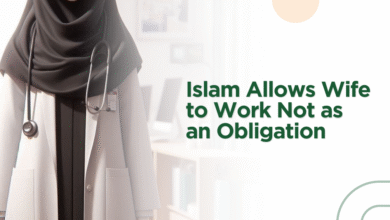

Have you ever heard someone say, “A woman’s place is at home, so why bother having all sorts of skills?”
Or the opposite, those who say, “If women only stay at home, they won’t develop!”
Both often appear. And oddly enough, both sides feel they are the most correct. And if you look closely, the discussion of women and skills often ends in one verse:
وَقَرۡنَ فِىۡ بُيُوۡتِكُنَّ
“And you should remain in your homes…” (Quran Surah Al-Ahzab [33]: 33)
Some people who are too rigid interpret this verse as if women are imprisoned in their homes. Conversely, those who are too liberal say this verse is no longer relevant and must be opposed.
In fact, the problem is not that narrow.
The order to stay at home doesn’t mean women are forbidden to work. It’s more of an affirmation of a wife’s primary mandate, the Mother of God, as educator, guardian, and manager of the home.
And interestingly, if we want to find the clearest example of how a woman can remain noble at home and be productive, just look at the house of the Prophet Muhammad ﷺ.
There is a figure whose name we often hear, but we rarely discuss her independent side, Zainab binti Jahsy ra
A noble woman, the wife of the Prophet ﷺ , but also a productive, independent, and generous leather craftswoman. Shouldn’t this answer many of our preconceptions?
Who is Zainab binti Jahsy?
Before discussing her skills, we need to first understand who she is. It’s clear that this exemplary behavior comes from a woman with a very high standing in the sight of Allah ﷻ and the Prophet ﷺ .
Sayyidah Zainab binti Jahsy ra is the cousin of Rasulullah ﷺ , one of the Ummul Mukminin ,
and the only wife of the Prophet ﷺ who was married directly by Allah ﷻ.
Allah ﷻ himself said:
فَلَمَّا قَضٰى زَيۡدٌ مِّنۡهَا وَطَرًا زَوَّجۡنٰكَهَا
“So when Zaid had ended his need for her, We married you to him (Zainab binti Jahsy) …” (Quran Surah Al-Ahzab [33]: 37)
Many scholars assert that this verse indicates a very special honor. Ibn Kathir even called it a gift not bestowed upon other women.
He is also famous for his worship. Umm Salamah ra said:
“Zainab was a pious woman, fasted a lot, and prayed diligently at night.”
So, before we talk about her skills, let’s first understand that she’s at a very high level. And a woman as noble as this actually has skills, a business, and a job.
Also read: Independent Ruqyah to Protect Your Heart and Business
Hands that work, hearts that give charity
Well, this is the part that is often overlooked in discussions.
Zainab binti Jahsy ra is a leather craftsman. In classical terms, he is called dabighah tanner. He takes the skin, processes it, sews it, until it becomes an item that is worth selling.
And everything is done at home. There’s no ikhtilat (intercourse with men), no violation of modesty, no non Islamic interactions. The Prophet Muhammad ﷺ knew this, and he didn’t forbid it. He even praised her generosity.
To the point that the Prophet ﷺ said to his wives:
أَسْرَعُكُنَّ لَحَاقًا بِي أَطْوَلُكُنَّ يَدًا
“The one who will follow me soonest (in death) is the one with the longest arm.”
(Hadith narrated by Muslim , no. 2452)
Initially, the wives thought “long arms” meant physical characteristics. But it turned out that the first wife of the Prophet ﷺ to die was Zainab.
This is where ‘Aisyah ra just understood:
فَعَلِمْنَا بَعْدُ أَنَّمَا كَانَتْ طُولَ يَدِهَا الصَّدَقَةُ
“…We just understood that the meaning of ‘long hands’ is the amount of charity…” (Hadith narrated by Bukhari, no. 1420)
He gave away almost all of his work. He worked, not to get rich, but to give. Beautiful, right?
In an era when some people work hard to improve their lifestyle, Zainab ra worked hard to elevate her status in the afterlife.
Also read: Business Competition, Is It Test or a Threat?
Productiveness is not about prestige, but about piety.
Zainab binti Jahsy ra was nicknamed, Ma’wal Masakin, the place where poor people return.
If anyone is in trouble, come to Zainab. Even in the final moments of her life, she was still thinking about charity. She made a will:
“I’ve prepared my shroud. If Umar buys one for me, please donate one of them.”
This noble woman wasn’t someone who worked out of necessity, nor because of economic necessity. She worked because she wanted to give back to charity.
And when he died, he left no legacy.
Not because he doesn’t have any, but because all the wealth he has earned has been given in charity in the way of Allah ﷻ
At this point, we must honestly ask ourselves: What is the true purpose of our work?
Zainab binti Jahsy ra taught that sharia-compliant works are born from a pious heart, not from material ambition.
Also read: What is Ghibtoh? The Kind of Good Envy
Conclusion: Home Is Not a Prison, Skills Are Not a Threat
The story of Zainab binti Jahsy ra is a gentle slap for all of us.
For a woman, home is not a prison. Women’s productivity is also not an enemy of sharia.
The problem is when productivity is used as an excuse to abandon the trust of the home, or when work is used as justification to open the door to slander.
Zainab ra showed the opposite, she remained at home, maintained honor, was productive, independent, generous, and all in obedience to Allah ﷻ .
That is a woman who works in real syar’i work.
Sometimes we forget, great civilizations are not born from people who are busy chasing recognition, but from people who work to increase their piety.
“The most noble work is not the most visible, but the most accepted in the sight of Allah ﷻ .”
May Allah ﷻ be pleased with Sayyidah Zainab binti Jahsy ra, the role model of a woman who works without violating the Shari’a, and without losing her glory as a house keeper.
Also read: Taqwa is The Strongest Shield Amidst Business Competition
Let’s Visit, Zeed and join for halal investment with Zeed.
Author: Redha Sindarotama
Reference:
Al-Qur’an. Al-Karim. Accessed from: https://quran.com/
Al-Bukhari. Sahih Al-Bukhari , Hadith no. 1420. Retrieved from https://sunnah.com/bukhari:1420
Muslim. Sahih Muslim , Hadith No. 2452. Accessed from https://sunnah.com/muslim:2452
An-Nabhani, Taqiyuddin. The System of Social Interaction in Islam (An-Nizhâm Al-Ijtimâ’î fi Al-Islam). Jakarta: Pustaka Fikrul Islam.
An-Nabhani, Taqiyuddin). Islamic Personality Volume I. Jakarta: Pustaka Fikrul Islam.